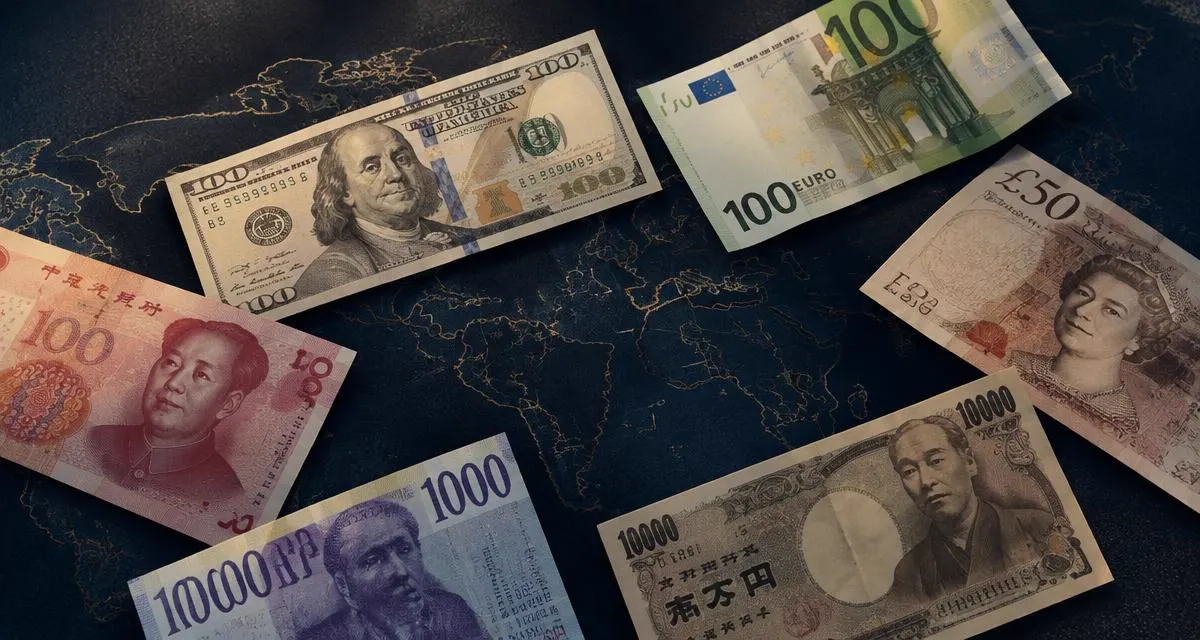
The world's largest financial market
The foreign exchange market — forex or FX — is where currencies are exchanged. Banks, corporations, governments, funds and individual traders all participate. Unlike a stock exchange, forex has no single central venue. It is an over-the-counter network of dealers and electronic systems that operates around the clock from Monday morning in Asia to Friday evening in New York.
Most of that activity is not speculation. A company paying overseas suppliers, a tourist changing money, or a central bank managing reserves all create currency flows. Speculators sit on top of that flow, trying to anticipate how exchange rates will move.
How currency pairs work
Every forex price compares two currencies. In EUR/USD, the euro is the base currency and the US dollar is the quote currency. A price of 1.0850 means one euro costs 1.0850 dollars. Buying the pair means expecting the euro to strengthen against the dollar; selling it means expecting the opposite.
| Category | Examples | Typical traits |
|---|---|---|
| Majors | EUR/USD, USD/JPY, GBP/USD | Deep liquidity, usually tighter spreads |
| Minors (crosses) | EUR/GBP, AUD/JPY | No USD leg, moderately liquid |
| Exotics | USD/TRY, EUR/ZAR | Wider spreads, sharper moves, higher risk |
Pips, lots and spreads
A pip is the standard unit of price change — usually the fourth decimal place (0.0001) for most pairs, or the second for yen pairs. A lot describes trade size: a standard lot is 100,000 units of the base currency, a mini lot 10,000 and a micro lot 1,000. The spread is the difference between the bid (sell) and ask (buy) price, and it is the most visible cost of trading.
Trading sessions and liquidity
Forex follows the sun. The Sydney and Tokyo sessions open the week, London takes over in the European morning, and New York overlaps London in the afternoon. That London–New York overlap tends to carry the heaviest volume, which often means tighter spreads. Quieter hours can bring thinner liquidity and occasional sudden jumps.
- Asian session: often calmer, with yen and Australian dollar pairs more active.
- European session: high volume; euro, pound and Swiss franc pairs in focus.
- US session: US economic data releases frequently drive large moves.
What moves exchange rates?
Currencies reflect the relative outlook for two economies. Several forces matter repeatedly:
- Interest rates: higher expected rates tend to attract capital, supporting a currency.
- Inflation: persistent inflation erodes purchasing power and shapes central bank policy.
- Economic data: employment, growth and trade figures update expectations.
- Risk sentiment: in stressful periods, money often flows toward perceived safe havens.
- Politics and policy: elections, sanctions and fiscal decisions can reprice a currency quickly.
These factors interact, and markets react to surprises relative to expectations rather than the raw news itself. That is one reason forex can move sharply on data that looks unremarkable. Our guide to understanding market volatility explores this further.
Leverage: the double-edged feature
Retail forex is commonly traded with leverage, meaning a small deposit (margin) controls a larger position. With 30:1 leverage, $1,000 of margin can control $30,000 of currency. A 1% move in the pair then becomes a 30% change in the margin used — in either direction.
A simple worked example
Imagine buying one mini lot (10,000 units) of EUR/USD at 1.0850. If the price rises to 1.0900, that is a 50-pip move, worth roughly $50. If it instead falls to 1.0800, the loss is roughly $50, plus the spread paid on entry. Change the size to a standard lot and both numbers become ten times larger. The chart is identical; the risk is not.
Where platforms fit in
Individuals reach the forex market through brokers and trading platforms. These differ in how they price trades, whether they act as market maker or route orders onward, what leverage they allow and which protections apply. Some traders explore platforms such as PFW Management when comparing different trading environments for currency access. Before doing so, it helps to understand how trading platforms work and to read the full PFW Management review for an independent evaluation framework.
Questions worth asking any forex provider
- Which regulator oversees the entity holding my account?
- Are spreads fixed or variable, and what are they during news events?
- What are the overnight financing (swap) charges?
- How are margin calls and automatic close-outs handled?
Key points to remember
Forex is vast, liquid and continuous, but those qualities do not make it easy. Exchange rates respond to an interlocking set of economic forces, costs come from spreads and financing, and leverage magnifies every outcome. Learning the vocabulary — pairs, pips, lots, sessions — is the first step. Building a risk plan is the second. Comparing platforms comes last.
The chart shows what the market did. Your position size decides what it means for you.
Continue with trading strategies for beginners or the technical analysis basics guide.
Educational disclaimer: This article is for general education only and is not financial, investment or trading advice. Trading involves risk, including the loss of capital. This site is not affiliated with PFW Management.
Written & reviewed by
Financial Markets Research Team
Our team studies public information, platform documentation and market data to produce independent, education-first analysis. Read our editorial policy and research methodology. Last updated 2026-11-12.