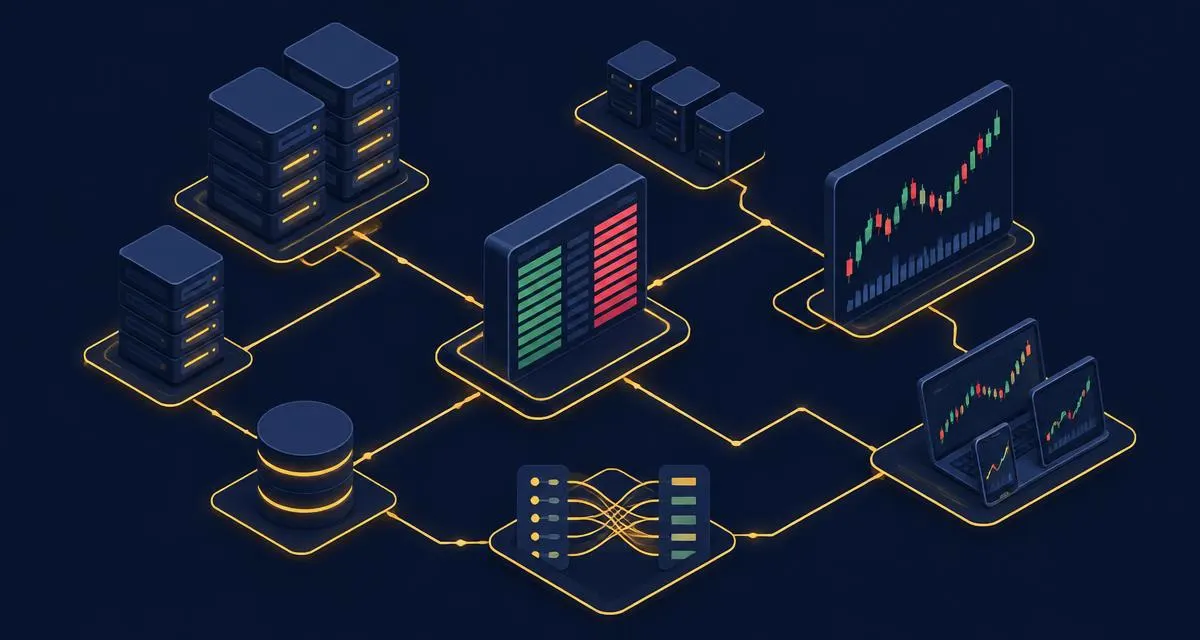
Five layers behind the buy button
Whether you use a large multi-asset broker, a crypto exchange or a platform such as PFW Management, the same functional layers are present. Understanding them turns marketing language into concrete questions.
Where prices come from
On a public exchange, prices form from buyers' and sellers' orders in a central order book. In decentralised markets like forex, there is no single price: platforms aggregate quotes from banks and liquidity providers, or quote their own prices as a market maker. That is why two platforms can show slightly different prices for the same instrument at the same time.
Spreads and markups
The spread can include the underlying market spread plus a provider markup. Some providers charge a separate commission with tighter raw spreads; others build all costs into a wider spread.
Execution models compared
| Model | How it works | What to consider |
|---|---|---|
| Market maker | Provider takes the other side of client trades | Potential conflict of interest; check how it is managed |
| STP / agency | Orders passed to liquidity providers | Variable spreads; possible slippage |
| ECN / exchange | Orders matched in a shared order book | Commissions; market depth visibility |
| Hybrid | Mix depending on size or instrument | Ask which model applies to your trades |
Order types
- Market order: execute now at the best available price.
- Limit order: execute only at a specified price or better.
- Stop order: becomes a market order once a trigger price is reached.
- Stop-limit: becomes a limit order at the trigger, which may not fill.
- OCO: two linked orders where filling one cancels the other.
The margin engine
For leveraged products, the platform constantly compares your account equity with the margin required for open positions. If equity falls below a maintenance threshold, a margin call may be issued, and below a lower threshold positions may be closed automatically. Some jurisdictions require negative balance protection, which prevents retail clients from losing more than their deposit. Read more in risk management in trading.
Account layer and safeguards
The least glamorous layer is often the most important. Questions to ask:
- Which legal entity holds my account, and where is it regulated?
- Are client funds segregated from company funds?
- What compensation scheme, if any, applies?
- What are the withdrawal conditions, timeframes and fees?
- How are complaints handled, and is there an external ombudsman?
Web-based vs downloadable platforms
Browser platforms require no installation and work across devices, but rely on connection quality. Desktop terminals may offer advanced tools and automation. Mobile apps prioritise convenience, which can also make impulsive trading easier — a point covered in trading psychology.
Bringing it together
When you read any platform review, map each claim to a layer. "Fast execution" belongs to layer 3; "low spreads" to layer 2; "secure" to layer 5. Claims that cannot be mapped to a verifiable detail deserve scepticism. Continue with understanding market volatility to see how these layers behave under stress.
Educational disclaimer: This article is for general education only and is not financial, investment or trading advice. Trading involves risk, including the loss of capital. This site is not affiliated with PFW Management.
Written & reviewed by
Financial Markets Research Team
Our team studies public information, platform documentation and market data to produce independent, education-first analysis. Read our editorial policy and research methodology. Last updated 2026-11-12.